

Review - Honor And Curse: Eternal #1
From Mad Cave Studios

A new series from Mad Cave Studios combining the past, present and more in Honor and Curse: Eternal #1.
An immortal ninja cursed with a vengeful war spirit is forced out of hiding to protect the last descendants of his sworn family, even if it means unleashing the monster within.
Six hundred years ago, shinobi warrior Genshi Sakagura was cursed to share his soul with a mythic spirit of war—the Tengu. Now immortal, he hides in modern-day New York, living in silence and penance, praying the curse stays buried. But when an ancient cult threatens the descendants of the family he swore to protect, Genshi must take up the blade again. To save them, he risks unleashing the monster inside—and becoming the very weapon the world fears most.
(W) Mark London (A) Jaime Infante
(C) Fran Gamboa (L) Carlos M. Mangual
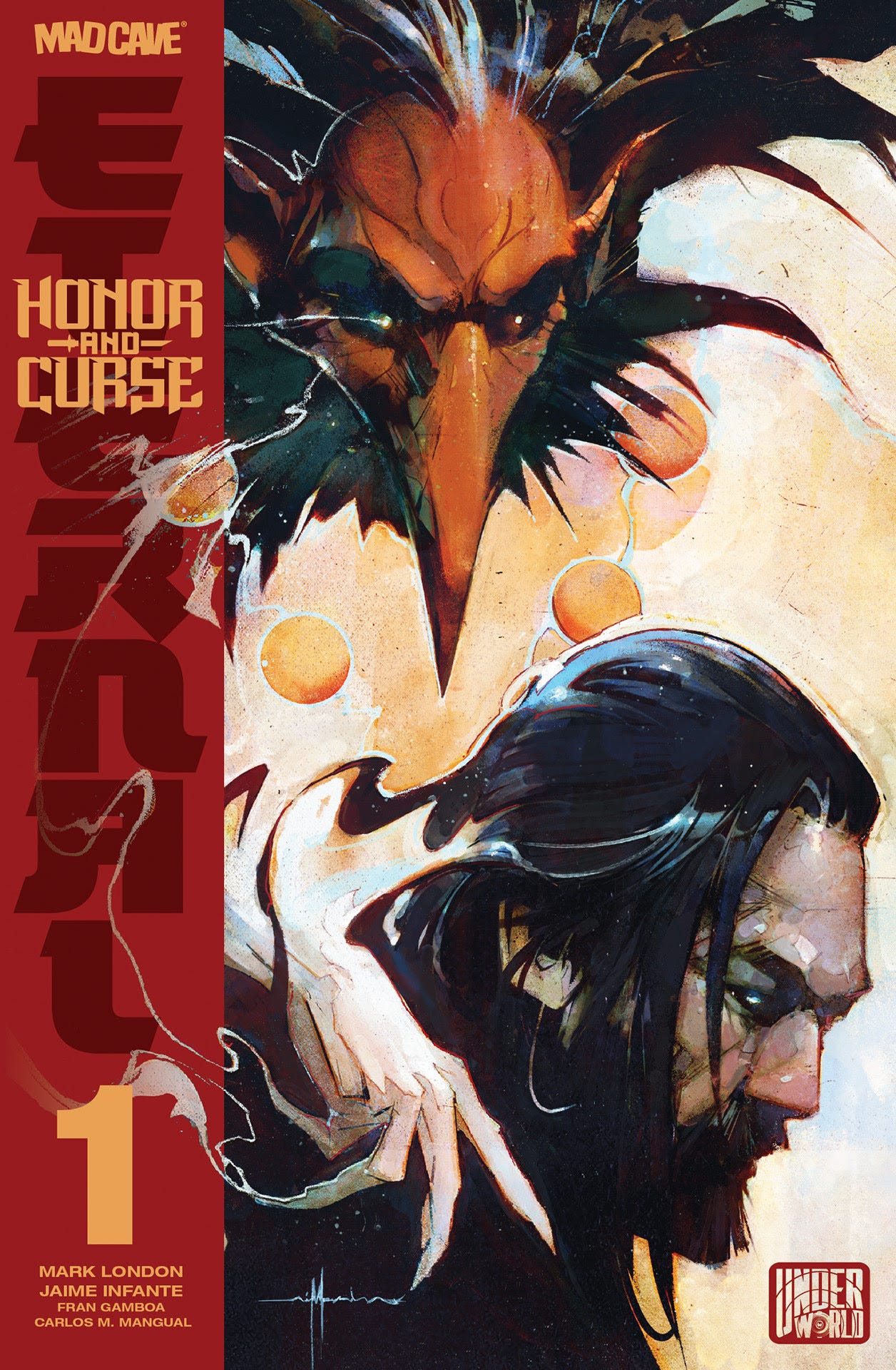
Honor and Curse: Eternal #1 from Mad Cave Studios immediately pulled me in. From the introduction alone, I was fascinated to see where this story might lead — and thankfully, it absolutely delivers on that early promise. It’s not an easy task to weave together ancient rituals, long-buried plans, sacred promises, and the looming presence of demons, especially amid a substantial time jump, but it manages to bring all those elements together in a way that feels cohesive rather than overwhelming.
The story's foundation lies in the past, where a warrior makes a difficult, defining decision—one that clearly carries enormous weight. We don’t get every detail laid out for us, and that restraint works in the story’s favour. Instead of handing us answers, it shows us consequences. Six hundred years later, those he once swore to defend are suffering, and it’s evident that his choice continues to echo through time. It’s a clever setup because it builds intrigue without overexplaining. We’re left with the understanding that there’s far more beneath the surface — and that certain forces would happily unleash this ancient spirit of war upon the modern world.
The scale of the story feels grand, almost mythic. There’s a sense that the stakes stretch far beyond any one individual. Yet at the centre of it all is Sakagura, isolated in his tower, cut off from most of the outside world and communicating only sparingly. Despite that solitude, he still finds ways to influence events and do some measure of good. That contrast — epic forces at play alongside a lone, reflective figure — adds emotional weight to the larger narrative.
Violence and action are still very much present, and they effectively bookend the issue. By placing intense sequences in both the distant past and the present day, the story allows us to see the cause-and-effect across centuries. The mirrored structure strengthens the theme that nothing is truly buried — actions ripple forward, and history refuses to stay silent. Viewing the events through both timelines adds depth to the narrative and encourages you to consider how each moment connects.
Visually, the book is stunning. The artwork carries a painted quality, particularly in the colouring, which gives the world a textured, almost mythological feel. Shadows are used powerfully, reinforcing the darker aspects of the story and the sense of looming threat. When light does break through, it’s dramatic — almost radiant — and it feels purposeful, as though we’re witnessing the raw power simmering beneath the surface.
Overall, this is a dark, layered, and intriguing start to what feels like an expansive story. It balances mythology with mystery, action with reflection, and leaves just enough unanswered to make the wait for the next issue feel essential rather than optional.
Get it at Forbidden Planet:
