

Review: Nectar #2
From Vault Comics

The horror continues as we discover more about what is happening and why in Nectar #2 from Vault Comics.
As the butterfly infestation spreads across Misery Island, and more people fall victim to their mind-altering sting, the village reverend rallies his flock to cast out the demonic plague—and the man he holds responsible for it: Amos Hall.
New York Times bestselling author Jeremy Robinson and Italian phenom artists Annapaola Martello & Francesco Francini horrify readers with a quaint village’s descent into madness.
Writer: Jeremy Robinson
Artists: Annapaola Martello & Francesco Francini
Colorist: Steve Canon
Letterer: Jim Campbell
Cover Art: Chris Shehan
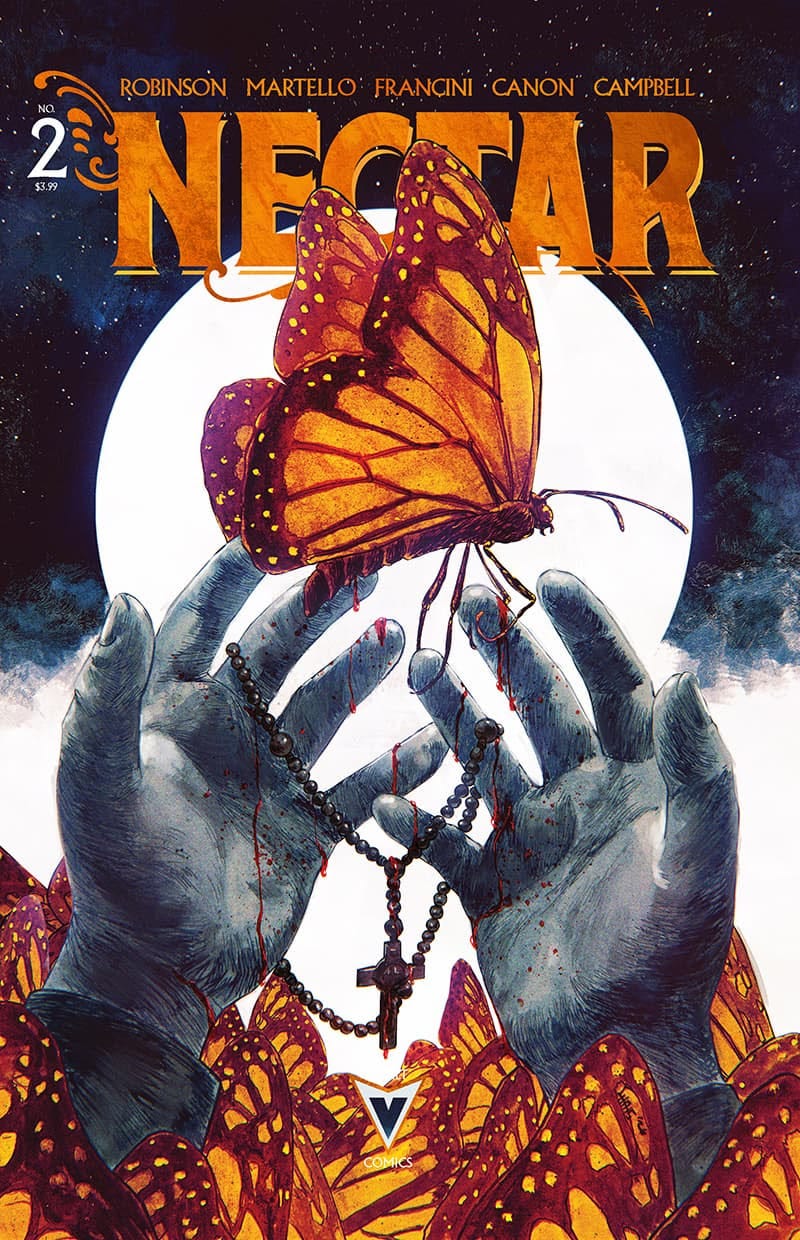
There’s something deeply unsettling about those brightly coloured butterflies, and this issue leans into that contrast brilliantly. Even without fully understanding what they are, their arrival carries a quiet, creeping dread. The way the swarm is presented—almost silent, yet overwhelming—adds a layer of tension that feels inescapable. It’s not loud or chaotic horror; it’s controlled, eerie, and all the more effective for it.
By this point, the connection between the butterflies and the so-called dancing plague is becoming clearer, but that understanding doesn’t make things easier. If anything, it complicates matters further. There’s a real sense of frustration in how knowledge is handled within the community—science and reason are available, but not everyone is willing to listen or accept what’s being discovered. That resistance feels very grounded, and it creates a believable conflict in which fear, ignorance, and opportunism collide. Some characters are trying to get to the truth, while others are clearly more interested in twisting events to suit their own agendas.
What makes the situation even more disturbing is the suggestion that the infection is no longer limited to those directly bitten. The idea that it’s spreading beyond its original cause raises the stakes significantly, turning a contained threat into something far more unpredictable. And despite the almost whimsical name, the “dancing plague” is portrayed here as pure horror. There’s nothing joyful about it—this issue really drives home the terror of losing control over your own body, of being forced to move without end. That loss of agency is where the true fear lies, and it’s depicted in a way that feels both intense and deeply uncomfortable. The nod to the real-world phenomenon only makes it more unsettling, grounding the story in something that feels just plausible enough.
The character work continues to be a strong point. There’s a sense that these are real people reacting in real time to something they don’t fully understand, and that uncertainty shapes their decisions. The issue does a great job of making you care about them—not just as participants in the plot, but as individuals whose fates feel increasingly precarious. There’s a genuine pull to learn more about who they are and where this is all going to take them.
Visually, the book remains striking. The darker, more oppressive tones of the world are constantly interrupted by the vivid, almost beautiful colours of the butterflies, and that contrast is what makes them so unnerving. They shouldn’t feel threatening, and yet they absolutely do. It’s that clash between beauty and danger that gives the horror its edge.
Overall, this issue builds confidently on what came before. It deepens the mystery, raises the stakes, and continues to blend atmosphere, character, and concept into something that feels genuinely unique.
Get it at Forbidden Planet:
