

Review - Post Malone's Big Rig: Volume 1
From Vault Comics

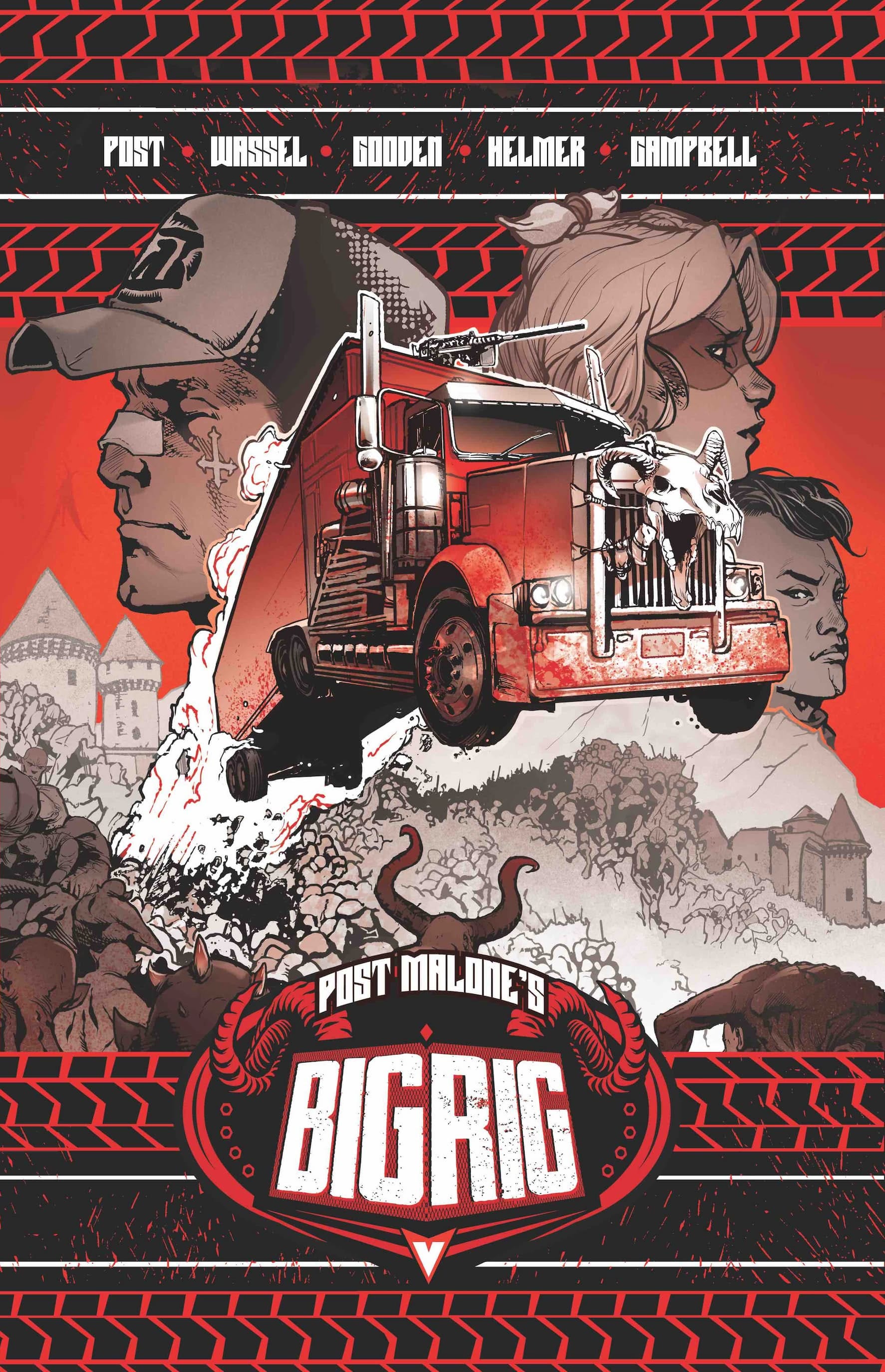
Post Malone’s Big Rig: Volume 1, is out now from Vault Comics, and I had a chance to have a look at the first volume.
THEY PRAYED FOR A MIRACLE. THEY GOT 25 TONS AND 18 WHEELS OF HOLY WEAPON.
Post Malone’s BIG RIG hits shelves in a collected trade paperback for the first time, containing all 8 chapters of Book One.
The Dark Ages… Demon hordes plague Europe as Hell invades Earth. The Six Petals, a secret sect of The Knights Templar, pray for a holy weapon to drive back the scourge. What crashes to earth instead is The Rig, a fully loaded tractor trailer. In the aftermath of its arrival, the only man left standing is an enigmatic former priest. He will become Trucker and lead the fight against Hell—with 25 tons and 18 wheels of demon-slaying machine.
Created by Post Malone. Written by Post Malone and Adrian Wassel. Drawn by Barbaric co-creator and Dark Knights of Steel artist Nathan Gooden.
Writers: Post Malone and Adrian Wassel, Created by: Post Malone, Artist: Nathan Gooden, Colorist: Der-shing Helmer, Letterer: Jim Campbell, and Cover Art: Nathan Gooden
This is an epic first volume that does a huge amount of heavy lifting in pulling you into its world, introducing its characters, and—most importantly—making you actually care about what happens to them.
Right from the opening pages, the stakes are made crystal clear. The demonic hordes aren’t some distant or abstract threat—they’re brutal, immediate, and relentless, cutting through villagers and their families without hesitation. There’s a real sense that nowhere is safe, that humanity is on the back foot, and that survival itself feels like a long shot. That atmosphere of desperation makes the arrival of the big rig feel almost mythic, like an answered prayer in the most literal sense.
And when someone finally steps up to take the wheel, it’s not just a random saviour—it’s this priest/warrior/trucker figure who already carries a lot of personal baggage. He’s not flawless or untouchable, which makes him far more interesting. Alongside his two companions, he doesn’t just defend—he goes on the offensive, taking the fight directly to the demons and their lords. That shift from survival to retaliation is where the story really finds its momentum.
The medieval setting adds a great layer to everything. You’ve got castles, faith, and old-world fears—but smashed together with big rigs, grenades, guns, and chainsaws. It sounds wild on paper, but it works because it fully leans into the idea's chaos. Instead of feeling out of place, the modern weaponry becomes a symbol of humanity finally having an edge against the darkness.
That said, the journey isn’t smooth. There are real bumps along the road for the crew, and the story isn’t afraid to deal in loss and death. What stands out is that none of it feels gratuitous or thrown in just for shock value. The darker moments—whether in the present or glimpsed through the characters’ pasts—add weight and depth. They help ground the more over-the-top elements of the story and remind you what’s at stake emotionally, not just physically.
When it comes to the enemies, the demons serve their purpose well. The hordes are there to be torn through in explosive, high-energy sequences, occasionally landing blows that remind you they’re still dangerous. But it’s the demon lords that really elevate the conflict. Each one presents a unique challenge, forcing the protagonists to adapt and push themselves further. You can feel the escalation as the volume progresses, culminating in a final confrontation that ups the ante in a big way—especially with the introduction of a rival rig, which adds a great mirror dynamic to the fight.
The artwork deserves a lot of credit, too. It’s consistently strong, with excellent use of contrast and colour to bring the world to life. The glowing sigils and effects stand out without overwhelming the panels, and the use of red in particular helps emphasise key moments—violence, danger, and intensity—without becoming repetitive. Character designs are distinct and expressive across the board, whether human or demonic, and you can really read their emotions in the details.
Overall, this first volume works brilliantly as an introduction. It throws you straight into the action but never leaves you lost, giving just enough context and character work to keep everything engaging and coherent. By the time you reach the end, you feel like you’ve been on a full journey—there’s a sense of payoff and satisfaction—but there’s also a clear hook for what comes next. It leaves you wanting more without feeling incomplete, which is exactly what a first volume should do.
Get it at Forbidden Planet:
