


After the last issue’s big event, a new adventure in Space Ghost #9 from Dynamite Comics.
As they mourn the death of Doctor Henry Contra, Space Ghost, Jan, and Jace find themselves trapped inside a gauntlet of their worst nightmares — courtesy of the Sorceress’s All-Seeing Eye! Can our heroes escape the Mistress of the Dimension of Science and Magic before it’s too late? Everything depends on their secret weapon... as Blip kicks off a dangerous psychic rescue mission!
Written by David Pepose, Art by Jonathan Lau, Colours by Andrew Dalhouse, and Lettering by Taylor Esposito
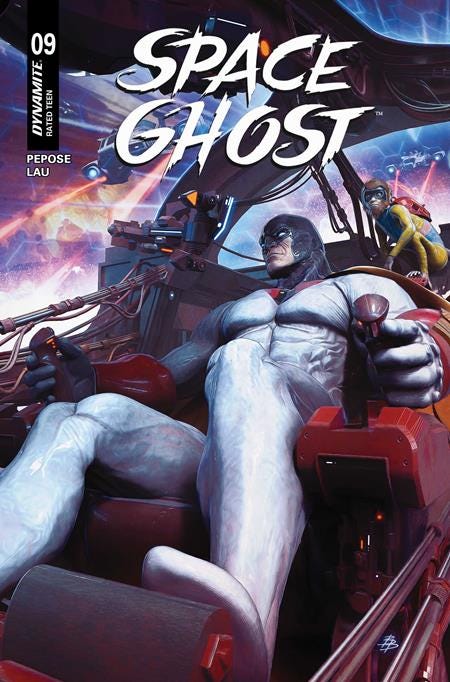
After the events of the previous issue, which very much felt like a major turning point, Space Ghost #9 works as a deliberate breather before the next big escalation. That doesn’t mean nothing happens, though. In fact, what this issue does quite well is continue to build the sense that something larger has been lurking in the background for a while. The threat to Space Ghost and his family has been hovering at the edges of the story for several issues now, and here we get perhaps the clearest indication yet that something — or someone — is actively moving against them. At the same time, it becomes clear that Space Ghost himself is not entirely unprepared; he has plans of his own and is clearly thinking several steps ahead.
One of the more interesting choices in this issue is that the story begins with the team already, in a sense, defeated. They aren’t tied up in the traditional action-comic way; instead, they're trapped inside their own minds, with their hopes, fears, and unresolved feelings turned into something very real. It’s a clever way of shifting the focus away from pure action and onto the characters themselves.
For Space Ghost, the dreamscape plays heavily on the guilt he still carries over what happened to the kids’ uncle. It’s something that has clearly stayed with him, and seeing it brought to the surface again adds a bit more emotional depth to his character. Jan, meanwhile, experiences a reunion with her uncle — both comforting and unsettling given the circumstances. It shows just how much that loss still affects her. Jace’s experience is slightly different: true to his character, he approaches the situation in a more straightforward, logical way. Even inside the illusion, he’s trying to think through the problem like a hero-in-training rather than simply reacting emotionally.
With the main trio trapped in their own mental prisons, it's Blip who becomes the unlikely hero of the issue. While the others are stuck in the dreamscape, Blip is the one who manages to break the cycle. Once the first crack appears and one of them manages to break free, the rest quickly follow — like a set of dominoes beginning to fall. It’s a fun twist that gives Blip a chance to shine and reminds readers that every member of the team has their role to play.
The issue itself moves along at a pretty brisk pace. It doesn’t linger too long in any one sequence, which keeps the story feeling energetic even though much of it takes place inside these mental landscapes. By the end, we also get at least a partial explanation for what’s going on and who might be responsible. It’s not a full reveal by any means, but it’s enough to push the bigger storyline forward and make the reader curious about what’s coming next.
On the visual side, the art really helps sell the concept of the dreamscapes. The way the different mental worlds are portrayed — blending action-hero imagery with more surreal science-fiction elements — works extremely well. There’s a real sense of movement and drama in the sequences, especially as the characters begin to break free from the illusions. The colouring in particular stands out, shifting tones and styles to help separate the different experiences in each character’s mind while still keeping everything visually cohesive.
Overall, issues like this are a great idea for the series. Not every instalment needs to be a massive action set-piece or universe-shaking event. Having an issue that sits between those bigger moments allows the story to breathe a little and gives the characters space to develop. It also lets the writers explore the personalities and motivations of both the heroes and their enemies in more detail. In the long run, that kind of character-building only makes the bigger events feel more meaningful when they arrive.
Get it at Forbidden Planet:
