


After the explosive ending of the last issue, the story continues in Speed Racer #7 from Mad Cave Studios.
After his crushing loss at the hands of the G.R.X. Engine, Speed Racer comes up with a dangerous plan to defeat the villainous Carl Cranem once and for all... that is, unless Pops can stop his hot-tempered son first! Can the Racers settle their long-standing differences in time for our hero to prevail on the tracks? Or will this rematch against Cranem and the G.R.X. finally put an end to Speed's quest for the Formula X Championship?!
Written by David Pepose, Art by Davide Tinto, Colors by Jão Canola & Lettering by Buddy Beaudoin
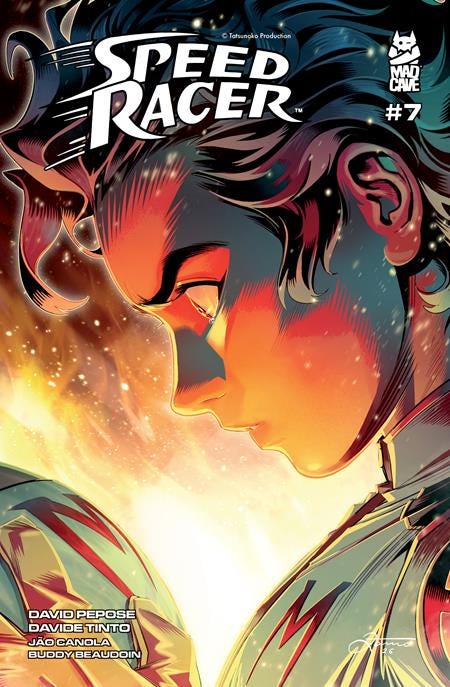
After the last issue, Speed finds himself in a difficult spot. There’s pressure coming from all directions—a new rival has entered the scene, one who has clear ties to his family’s past, and at the same time, there’s growing tension between Speed and Pops. It leaves Speed feeling off-balance, unsure of himself in a way we don’t often see.
So how does he deal with it? The only way he really knows how—on the track.
Speed Racer #7 leans into that idea, and in doing so, it draws clear inspiration from one of the great racing movies, Cars. Instead of focusing purely on the high-tech spectacle of the races, this issue shifts gears and puts the spotlight on the driver rather than the machine. It’s about the human element—the instincts, the mindset, and the emotional weight that comes with being behind the wheel in such dangerous conditions.
That shift works really well. Pops steps in not just as a mechanic or mentor, but as a teacher in a broader sense. The lessons he gives Speed go beyond racing technique; they’re about patience, perspective, and, most importantly, humility. It’s that theme that really carries through to the end of the issue, where Speed starts to show growth in a way that feels earned rather than forced.
At the same time, the book doesn’t lose sight of what makes it exciting. There are two standout racing sequences that deliver on both action and storytelling. They’re not just there for spectacle—they actively reinforce the issue’s core message. The panel layouts are well thought out, guiding the reader through the speed and chaos while still keeping everything clear and engaging. You can feel the tension building as Speed pushes himself, chasing not just victory, but redemption.
By the end, this feels like a strong conclusion to the short arc. It moves Speed forward as a character, addresses some of the emotional friction that’s been building, and gives us a more grounded look at who he is beneath the helmet. At the same time, it briefly steps away from the larger, ongoing threads surrounding Speed and his family, giving this story room to breathe and stand on its own.
Overall, it’s a satisfying issue that balances action with character development, showing that sometimes the most important progress doesn’t come from winning a race, but from understanding how—and why—you’re running it in the first place.
Get it at Forbidden Planet:
