


More action and more mystery in Teenage Mutant Ninja Turtles #16, out now from IDW Publishing.
It’s Ujigami vs. Casey Jones, with Raphael caught in the middle! The Ujigami has vowed to protect the Turtles from their greatest enemies, so why is he attacking Casey? Meanwhile, Shinigami goes behind Karai’s back to make a power play of her own, involving a dangerous new ally. The first step in their plan requires blood from a very specific target... and in very large amounts!
Author: Gene Luen Yang
Artist: Freddie Williams II
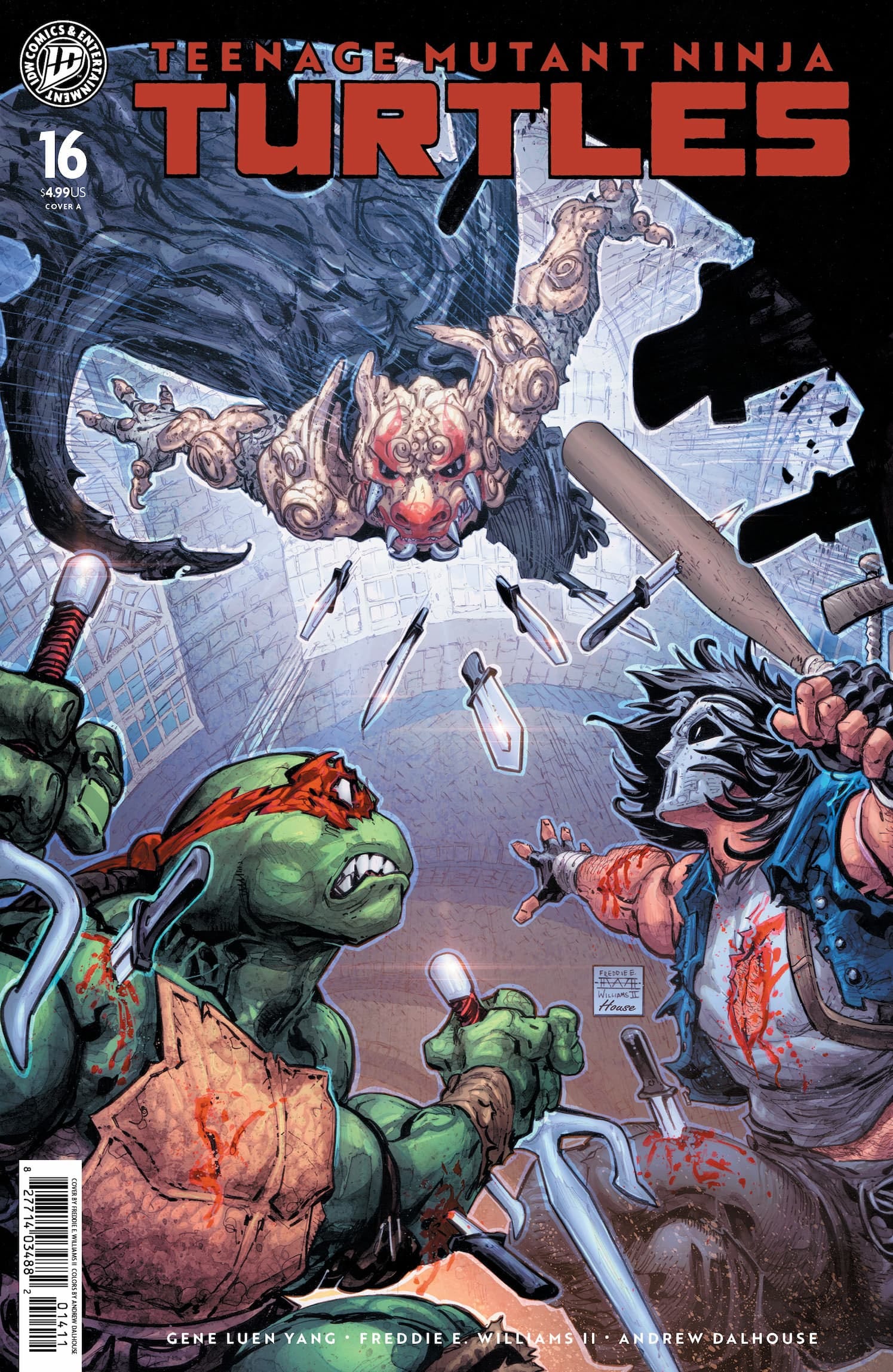
Following the big revelation in the previous issue, Teenage Mutant Ninja Turtles #16 wastes very little time getting straight into the confrontation that had clearly been building — the clash between Casey and Ujigami. There’s a real sense of tension hanging over the opening pages because the situation feels like it could spiral out of control very quickly. Fortunately, the Turtles arrive in time to stop things from going completely off the rails, but that doesn’t mean things calm down right away. Instead, the issue quickly turns into a fast-moving, action-heavy sequence where everyone is trying to gain the upper hand. The fight scenes come thick and fast, and it feels like the story barely pauses for breath while everything plays out.
Once the immediate chaos settles and the dust begins to clear, the story takes an unexpected turn. The brothers find themselves caught in a strange, trance-like state in which their deepest wishes and desires seem to be being fulfilled. At first, this appears almost peaceful, but it quickly becomes clear that something isn’t right. Each of them is essentially trapped in a fantasy tailored perfectly to them, which makes it all the more difficult to break free.
What makes this section particularly interesting is that it’s Michelangelo who ultimately manages to escape first. Unlike his brothers, Mikey’s lingering self-doubt and uncertainty actually become the thing that saves him. Because he’s so used to questioning himself and feeling like the odd one out compared to the others, the illusion doesn’t fully convince him. That crack in the illusion allows him to realise what’s happening and break free, and from there he’s able to pull the others out as well. It’s a clever bit of character work that gives Michelangelo a moment to shine in his own right. Too often, he is overshadowed by the stronger personalities of Leonardo, Raphael, and Donatello, but here he gets to be the one who saves the day through his own perspective and personality rather than sheer strength or leadership.
Meanwhile, things aren’t exactly going smoothly for Splinter either. While the situation with the Ujigami persona seems to have been resolved — at least on the surface — it quickly becomes apparent that this storyline is part of something much bigger. The issue begins to peel back the curtain a little more on where all of this might be heading. In particular, we start to get a clearer sense of Karai’s role in the larger scheme of things and how she may be influencing events behind the scenes. It adds another layer of intrigue to the ongoing story and hints that the family may face more complex challenges ahead.
One of the strongest aspects of this issue is the amount of world-building that continues to take shape around the characters. The series has been steadily expanding its mythos, blending the Turtles' ninja roots with mystical and supernatural elements, and this issue continues that trend. By the time we reach the final pages, the story delivers a genuine emotional gut punch — the kind of moment that lands hard because of everything that has been built up beforehand. It’s the sort of development that could have serious ramifications for the family dynamic moving forward and might make things a lot more complicated and awkward between certain characters.
On the artistic side, the book continues to impress. The artwork does a great job of balancing the two main elements of the story: the high-energy ninja action and the mystical, magical aspects of the plot. The fight scenes are dynamic and fluid, giving a strong sense of motion, while the supernatural sequences feel visually distinct without clashing with the book's overall style. The colouring plays a big role in this, especially during the dreamscapes. Michelangelo’s sequence, in particular, is handled extremely well, with the visuals reflecting his personality and inner struggles in a way that helps sell the emotional side of the story while still keeping the action's pace moving.
Get it from Forbidden Planet:
