

Review: Where Does The Rainbow End? #1
From Mad Cave Studios

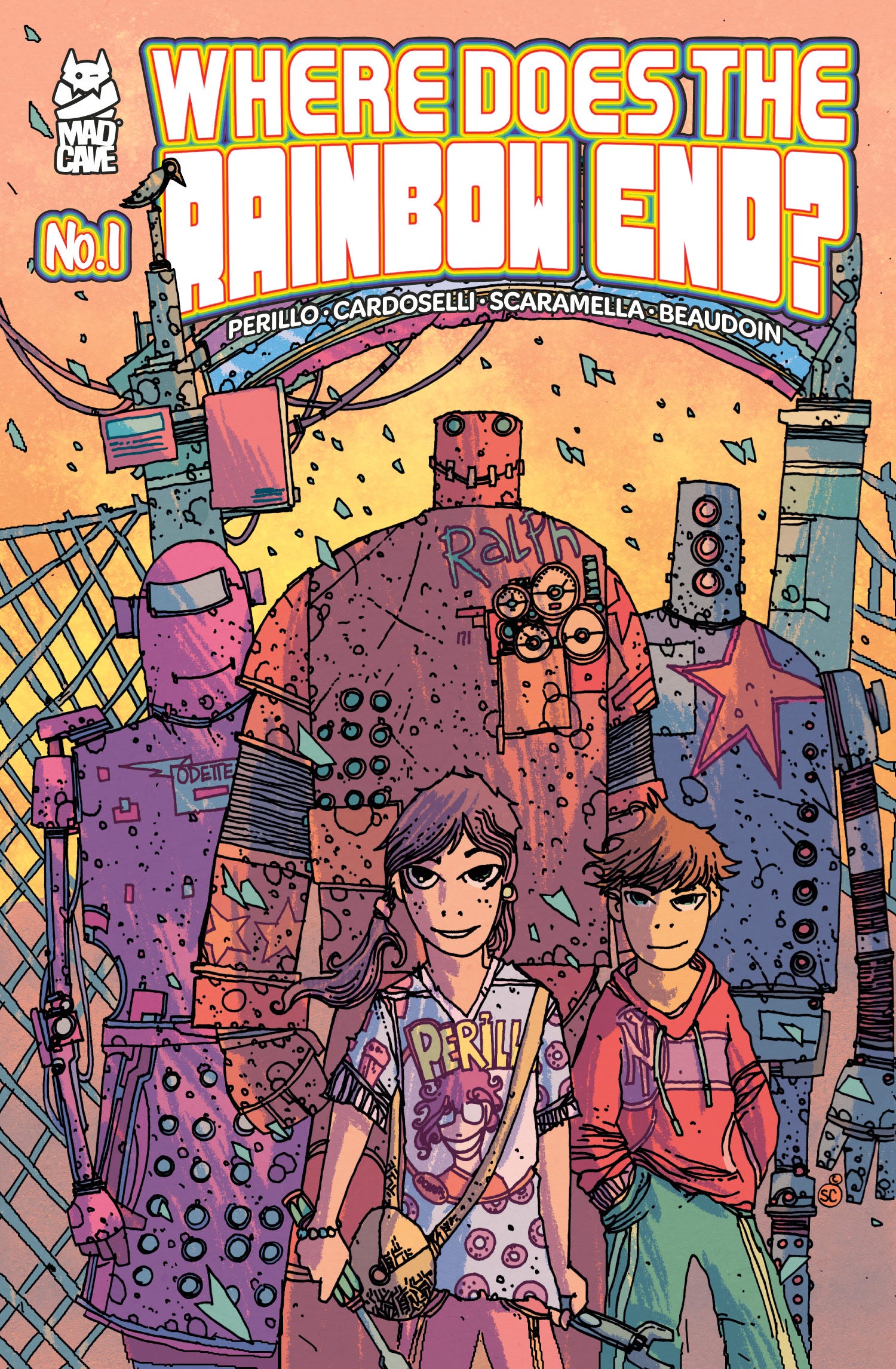
New from Mad Cave Studios is a new series beginning this week with Where Does the Rainbow End? #1.
A dramatic prequel to the hit story Love Me: A Romance Story, written by Francesca Perillo and drawn by Stefano Cardoselli. This story addresses universal themes of friendship, family, equality, and finding one’s own truth.
Gilda has been abandoned by her parents, but fortunately, she has been discovered in the Cacace Bros. Robot Dump…and has been raised by the robots who discovered her. She was lucky to be found in the Rainbow Sector by robots that cared for her. However, she has also been shielded from the outside world, other humans, and from a dangerous section of their robot world called the Dark Cage, where the most hostile of robots live. Word has spread about her ability to fix robots, though, and one vicious robot from the Dark Cage wants her to repair all of the violent robots that live there…and nothing will stop him. Artist Stefano Cardoselli (Don’t Spit In The Wind, Long Cold Winter) and writer Francesca Perillo (Long Cold Winter) reunite once again in this exciting prequel to their hit story Love Me: A Romance Story.
(W) Francesca Perillo (A) Stefano Cardoselli (C) Lorenzo Scaramella (L) Buddy Beaudoin
I have to confess, I haven’t read Love Me: A Romance Story, but that doesn’t appear to be a prerequisite for enjoying Where Does the Rainbow End #1. As a prequel, this first issue does an excellent job of standing on its own, welcoming new readers into its world without ever leaving them feeling they’re missing vital context.
From the outset, this is an enjoyable and clever read, with some genuinely strong world-building. The opening pages make great use of maps and in-universe explainers, grounding us in the setting and giving the book a sense of history and structure before the narrative properly begins. It’s a confident way to draw the reader in and immediately signals that this is a carefully thought-out universe rather than a simple backdrop.
The story opens on a surprisingly warm note, with a robot worker going about his duties with a grin. That sense of routine is soon shattered by the discovery of a baby—a moment that neatly upends expectations and becomes the emotional heart of the issue. What follows is a thoughtful “bring up the baby” storyline, as the robot community collectively decides to raise the child as their own. Watching this found family dynamic unfold is one of the comic’s greatest strengths, balancing gentle humour with genuine tenderness.
As the baby, Gilda, grows older, the narrative smartly shifts focus. We see the lengths the robots go to shield her from the dangers of the outside world, reinforcing both their protectiveness and the underlying threat beyond their borders. At the same time, Gilda’s natural aptitude for fixing robots begins to emerge — a skill that is both impressive and ominous. It’s clear early on that this talent will not go unnoticed and that it may ultimately place her in danger.
That tension comes to the forefront as the issue introduces those who wish to exploit her abilities. This development neatly resolves the first major plot thread while also setting out the book’s mission statement for what’s to come. It also delivers a genuine shock for Gilda in the form of meeting someone new — a moment that feels loaded with narrative promise. Are these elements connected? The issue wisely leaves that question hanging, ensuring plenty of intrigue going forward.
Tonally, this is a lovely and surprisingly heartfelt read. The choice to present robots not as cold, purely functional beings but as a family unit capable of love and care gives the story a fresh and engaging perspective. The lighter moments of raising a child are genuinely charming and often made me smile, while the looming threat of more hostile robots is presented with a stark, hellish edge that prevents the book from becoming too cosy.
The art style complements the story beautifully. Rich, vibrant colours bring the world to life, while expressive character work gives the robots a remarkable amount of personality. The vehicle and robot designs are particularly impressive, blending creativity with a sense of weight and function that makes the setting feel lived-in and believable.
Overall, Where Does the Rainbow End #1 is a strong opening issue that blends warmth, mystery, and thoughtful science fiction ideas. It’s an inviting entry point for new readers and an emotionally resonant start to what looks to be a compelling series.
Get it at Forbidden Planet:
Pre-order the TPB at Amazon:
